Blog

  • Hello world!

    Welcome to WordPress. This is your first post. Edit or delete it, then start writing!

  • Evictions at NYCHA ‘PACT’ properties mirror private housing in NYC, audit finds

    Evictions at NYCHA ‘PACT’ properties mirror private housing in NYC, audit finds

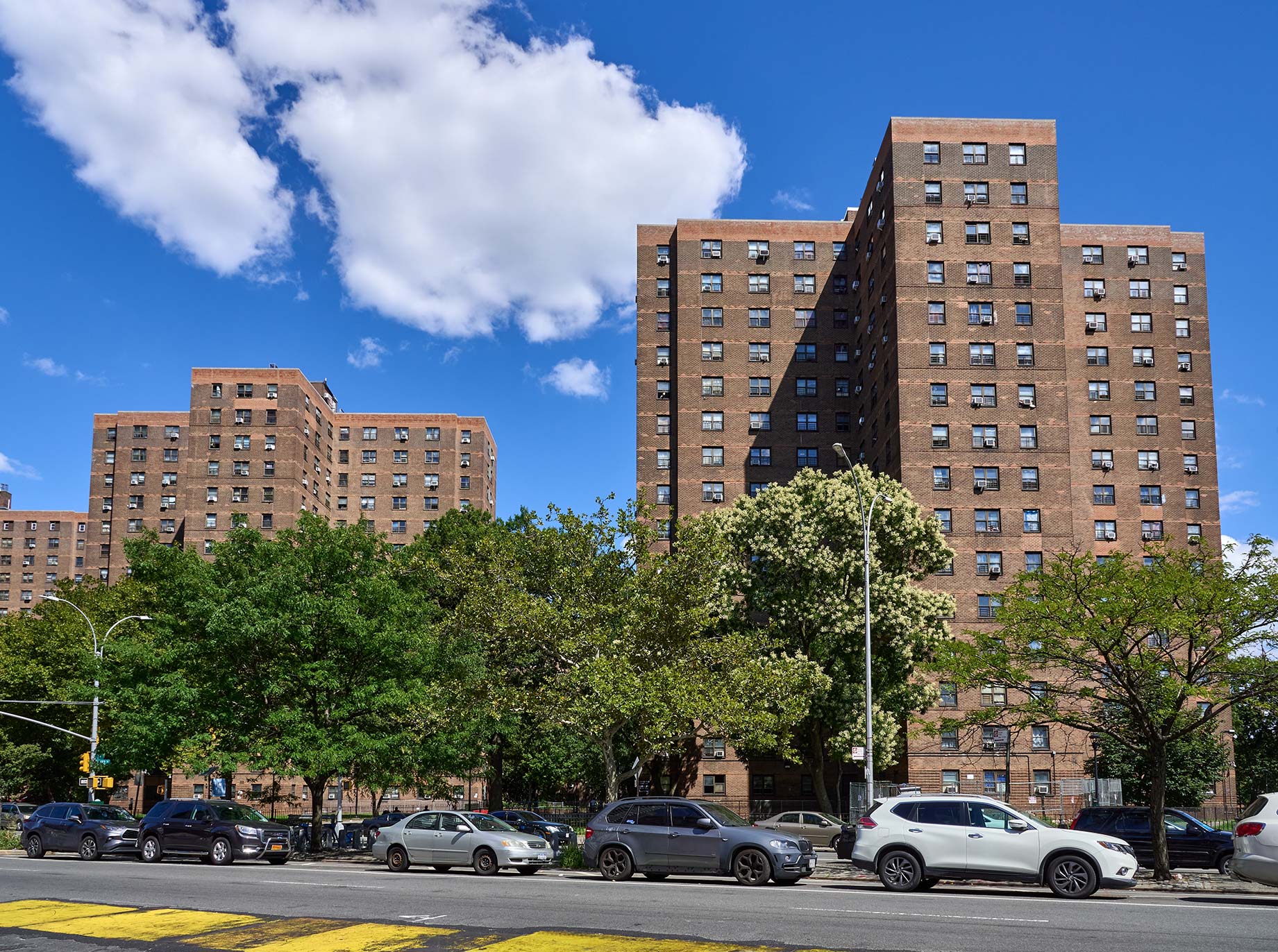
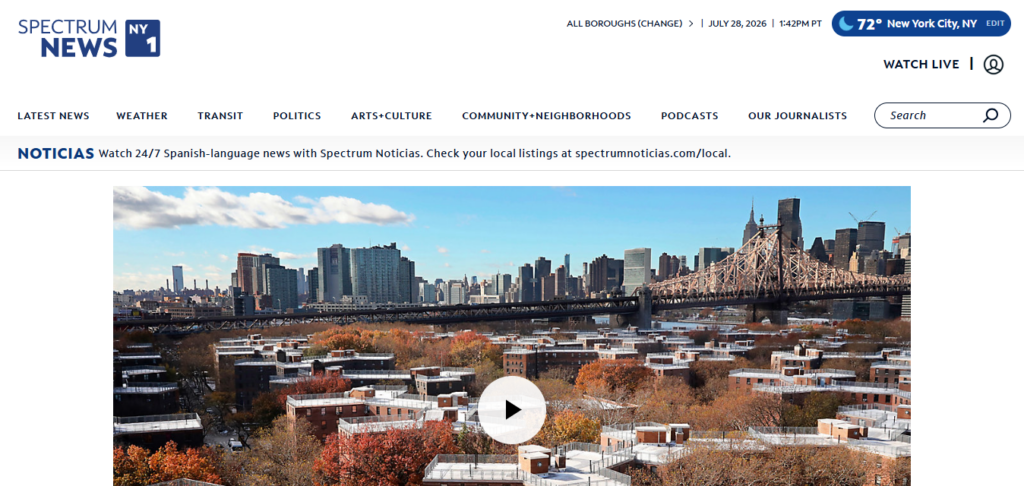
    Eviction rates at New York City Housing Authority properties managed under the Permanent Affordability Commitment Together, or PACT, program are significantly higher than those at traditional NYCHA developments, a new audit from Comptroller Brad Lander’s office found.

    In Fiscal Year 2024, the eviction rate for PACT properties was 0.57%, compared to just 0.12% for traditional NYCHA developments. These rates now mirror those of private rental housing in the city, according to the audit.


    What You Need To Know

    In Fiscal Year 2024, the eviction rate for PACT properties was 0.57%, mirroring those of private rental housing in the city, according to the audit
    The audit highlighted that eviction rates varied among PACT operators. While some have been aggressive with evictions, others have not gone ahead with any
    Comptroller Brad Lander joined “Mornings On 1” on Wednesday to discuss the audit

    “NYCHA is facing a huge backlog — nearly $80 billion in repair needs, and that’s why this PACT program is on the table, it unlocks some money for repairs,” Lander said during an interview with “Mornings On 1” on Wednesday.

    The PACT program, an initiative that partners with private companies to manage and repair public housing developments, promises faster repairs while maintaining affordability. However, many residents are worried about the risks of eviction under private management.

    “Residents said to us, ‘OK, but with private managers we also wanna know: What’s it look like on the other side? Will you take a look and compare eviction rates?’” Lander explained. “We have a NYCHA Resident Audit Committee — they selected this audit, and that’s why we did it.”

    The audit highlighted that eviction rates varied among PACT operators. While some have been aggressive with evictions, others have not gone ahead with any.

    “And NYCHA doesn’t have much oversight from the differences between development to development. That’s one of the recommendations that we made. So hopefully they’ll fix that,” Lander said.

    The report also found that NYCHA’s lack of standard operating procedures has left critical procedures — like pre-eviction outreach and eviction filings — inconsistent across PACT developments.

    “NYCHA should do better oversight of the PACT developments, so it doesn’t vary so much by development,” Lander said. “And then tenants deserve all the information, so as they’re weighing their future, they have the information they need.”

    Currently, NYCHA residents can choose to remain in traditional public housing, transfer to the newly created Public Housing Preservation Trust or join the PACT program. Lander said the goal of the audit is to help residents make informed decisions about their housing options.

    “If you go and see repairs being done, you think, ‘Good, I wanna get some repairs,’” Lander said. “If PACT will get me repairs, maybe that’s a good idea. Now they can say, ‘OK, but I also want to make sure I’ve got a home for the long term, and I can weigh those options with all the information.’”

    The audit’s recommendations include better oversight from NYCHA to standardize practices across PACT developments and ensure tenant protections are consistently applied.

    In a statement, NYCHA defended the introduction of the PACT program, saying it has invested “an unprecedented $7 billion to redevelop and renovate NYCHA apartments and communities, fundamentally transforming physical conditions and improving quality of life for thousands of public housing residents.”

    “After decades of federal disinvestment, PACT is one of the most successful long-term strategies for recapitalizing and preserving crucial affordable housing stock. In this report, the Comptroller’s Office does not take into account NYCHA’s financial and operational challenges and provides only a superficial assessment of the Authority’s work with no substantive programmatic recommendations,” the statement read.

    NYCHA said that there have been “very few” eviction at PACT-operated properties, adding that the program “upholds resident rights and protections and provides households with ongoing social services and financial assistance to resolve existing rental arrears.”

    “NYCHA and its PACT program undoubtedly prioritize keeping New Yorkers housed, and any suggestion otherwise is misguided and false,” the statement said.

  • Private company running Brooklyn public housing complex fired for repeated failures

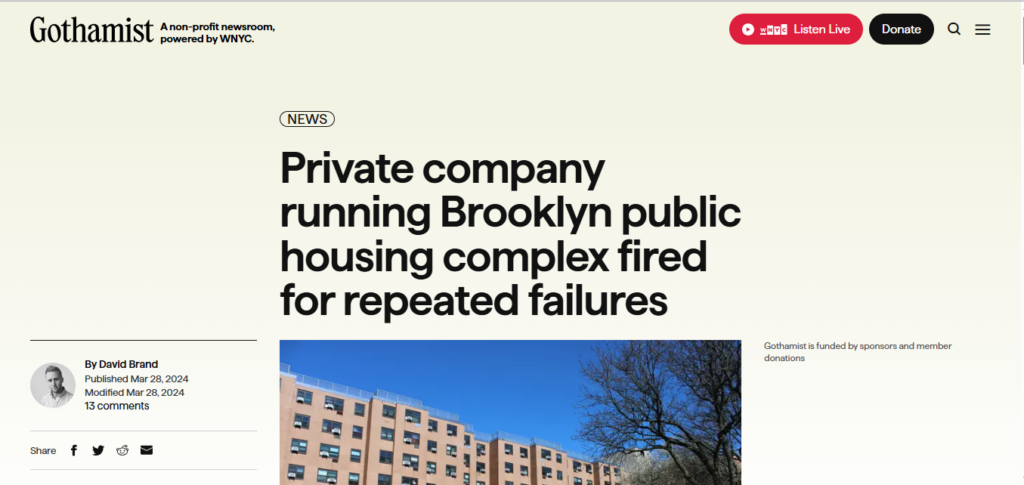
    Private company running Brooklyn public housing complex fired for repeated failures

    We rely on your support to make local news available to all

    Make your contribution now and help Gothamist thrive in 2026. Donate today

    Gothamist is funded by sponsors and member donations

    A private company managing a Brooklyn public housing complex was quietly fired late last year after the developer who hired the firm said it put tenant subsidies at risk, struggled to complete work on time and failed to get a handle on “ballooning” costs at the 1,300-unit campus.

  • Hundreds Threatened With Eviction in Botched NYCHA Paperwork ‘Crisis’

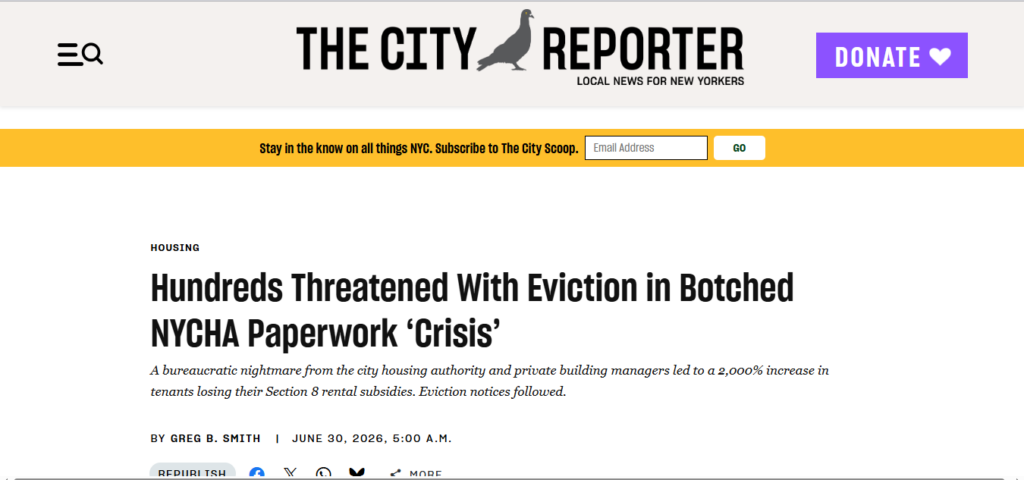
    Hundreds Threatened With Eviction in Botched NYCHA Paperwork ‘Crisis’

    A bureaucratic nightmare from the city housing authority and private building managers led to a 2,000% increase in tenants losing their Section 8 rental subsidies. Eviction notices followed.

    Find our journalism more easily when you are searching for local coverage.

    Add The City Reporter on Google

    The New York City Housing Authority mistakenly informed private management companies of public housing that hundreds of tenants had been cut off from federal rent subsidies, triggering eviction notices and frightening residents who insist they’ve paid their rent on time without fail.

    The erroneous cutoffs occurred at multiple NYCHA developments run by private firms the housing authority relies on to manage properties under a controversial program called Permanent Affordability Commitment Together, or PACT.

    The problem appears to be a paperwork screwup, with NYCHA informing tenants their Section 8 rent subsidies were going to be terminated because the housing authority believed they had failed to recertify their income and household makeup, as required each year.

    The number of Section 8 terminations over recertification jumped nearly 2,000% in the space of a single year, according to data from the Legal Aid Society. 

    But tenants say they’ve filed everything as required, and on Friday NYCHA officials admitted  that a huge backlog in processing recertifications resulted in wrongful Section 8 terminations. In response, the building management companies began billing tenants for the full, unsubsidized rent.


    No paywall here. THE CITY is a free-to-read, independent newsroom covering the stories that help you understand NYC. Sign up to get our headlines in your inbox.Sign up


    Surge in Section 8 Terminations

    Tenants meet at St. Paul Community Baptist Church in East New York, Brooklyn, for a rally Metro Industrial Areas Foundation and East Brooklyn Congregations flagging a wave of evictions at several privately run New York City Housing Authority developments.
    Tenants meet at St. Paul Community Baptist Church in East New York, Brooklyn, for a rally hosted by Metro IAF and East Brooklyn Congregations flagging a wave of evictions at several privately run NYCHA developments, June 28, 2026. Credit: Metro Industrial Areas Foundation

    We cover NYC, on historic days and every day.

    Sign up for free morning headlines in your inbox.Sign up

    “NYCHA has met with legal and advocacy groups to discuss a scanning backlog issue the Authority experienced which resulted in erroneous termination warning letters being sent to some households,” spokesman Andrew Sklar told The City Reporter. “This scanning backlog has since been resolved and we are committed to improving our systems and processes as well as our communication with residents regarding their legal obligations.” 

    The scope of the issue is not completely clear, but the nonprofit New York Legal Assistance Group says they experienced a significant uptick in calls from voucher holders and community partners who were distressed because they received termination notices related to recertification issues. This issue was elevated to NYCHA to address.

    A public records request by the Legal Aid Society revealed the number of Section 8 terminations due to failure to recertify jumped from 42 in 2024 to 836 last year.

    On Sunday, the housing advocacy group Metro Industrial Areas Foundation held a rally in East New York on the issue, singling out three developments there — the Linden, Boulevard and Penn-Wortman Houses — where they say hundreds of families who thought they were following the rules are now fighting to keep their apartments.

    ‘Crisis’ For Families

    Yolanda Moore, a tenant in the Boulevard Houses and a leader of East Brooklyn Congregations/Metro IAF, said both NYCHA and the private building managers share blame for the quagmire, charging that NYCHA loses recertification paperwork while building managers “have been unable to navigate the Section 8 recertification system sufficiently.”

    “We are seeing a recertification crisis in PACT,” Moore said. “We were promised PACT would make our homes stable and decent. Yet Linden, Boulevard and Penn-Wortman alone have hundreds of people in housing court for non-payment — and we know many of them paid their rent. We also know this is happening in many developments citywide.”

    Housing court records show that Stanley Avenue Preservation LLC, the entity managing Penn-Wortman and Linden, has filed more than 900 eviction proceedings against tenants there since 2023, almost exclusively for non-payment. The New York Legal Assistance Group said it’s not clear how many are related to the Section 8 cutoffs.

    NYLAG associate director Anna Luft said no one — neither the housing authority nor the PACT building managers — seemed to know precisely what was causing the problem: “There’s confusion with tenants. There’s confusion with building managers in the management office. They don’t seem to ever have a clear answer on what to do and when to do it. Because the way it’s been implemented, there’s been no clear structure.”

    Seeking Mamdani’s ‘Heavy Hand’ 

    She said tenants are now looking for help from Mayor Zohran Mamdani — who has promised increased attention to NYCHA’s struggles — to create a system that actually functions.

    “It will take a very heavy hand from the mayor’s office to structure this,” Luft said, “because up until now, NYCHA has not demonstrated any willingness to foster the structure for this program to run smoothly.”

    Mayor Zohran Mamdani speaks at about installing electrical heat pumps at a Far Rockaway NYCHA complex,
    Mayor Zohran Mamdani speaks at about installing electrical heat pumps at a Far Rockaway NYCHA complex, Feb. 4, 2026. Credit: Ben Fractenberg/THE CITY

    Under PACT, the housing authority retains ownership of properties but turns over management to private sector firms. Tenants in PACT developers are still required to pay rent, but their share is capped at no more than 30% of their income. The rest is subsidized by Section 8 housing vouchers.

    To retain this subsidy, all households must file annual paperwork re-certifying their incomes and household makeup. Tenants say they have filed the required documents — only for the housing authority to terminate their subsidies for not recertifying. 

    Massive Arrears

    Without the Section 8 subsidy, PACT building managers then began charging their full, unsubsidized, rent amount, while tenants continued to pay at the subsidized rate, leading to massive arrears and eviction proceedings.

    NYCHA claimed one tenant — who insists they filed all the required documents — owed a stunning $80,000 in back rent.

    “I’m talking about people who do everything they’re supposed to do and there’s still a delay” addressing the paperwork problem, Luft said. “It could be paperwork that was lost by NYCHA or the (private sector manager) and during that time, they’re being charged unaffordable rent.”

    Luft’s organization has seen this issue surface “in multiple developments across the city,” she said.

    Housing authority officials said the erroneous subsidy terminations only occurred with tenants who submitted their paperwork via the mail or through walk-in centers — which, more often than not, is the favored method of seniors living in public housing.

    One resident of the Linden Houses in East New York said the ordeal of trying to reverse her Section 8 termination had caused her blood pressure to increase. Credit: Ben Fractenberg/THE CITY

    At the Linden Houses in East New York, tenant leaders and longtime residents Stanley and Leslie Fields say they struggled for months to straighten things out after they started getting billed for market rate rent. Leslie Fields, 69, told The City Reporter that every time she filed the paperwork for recertification, she would get a message that she still needed to recertify.

    “I was running back and forth, doing everything I could to comply,” she said. “At the same time it was really raising my blood pressure because I just wanted to get it done and finished.”

    In one visit to NYCHA’s office to deliver her paperwork, she said the staffer couldn’t figure out how to use the on-line portal to register the information. During another visit, the NYCHA management employee said “he couldn’t understand why my rent was going up and my subsidy was going down. It was ridiculous.”

    Before the matter was resolved, the Fieldses were paying a higher than normal rent.  They are hoping to obtain a credit toward future payments.

    A 63-year-old who lives with her son in a two bedroom apartment in the Penn-Wortman development in East New York, who spoke on the condition that she remain anonymous because she doesn’t want to alienate NYCHA, said she’s been struggling to straighten out her situation for nearly a year.

    At her development’s management office, “The lady told me I had to go back to downtown NYCHA and she gave me questions to ask them about why they’re billing for market rate rent,” she said. “I shouldn’t have to pay that, because I did what I was supposed to do.”

    Workers hang a frame on the faced of the Boulevard Houses in Brownsville.
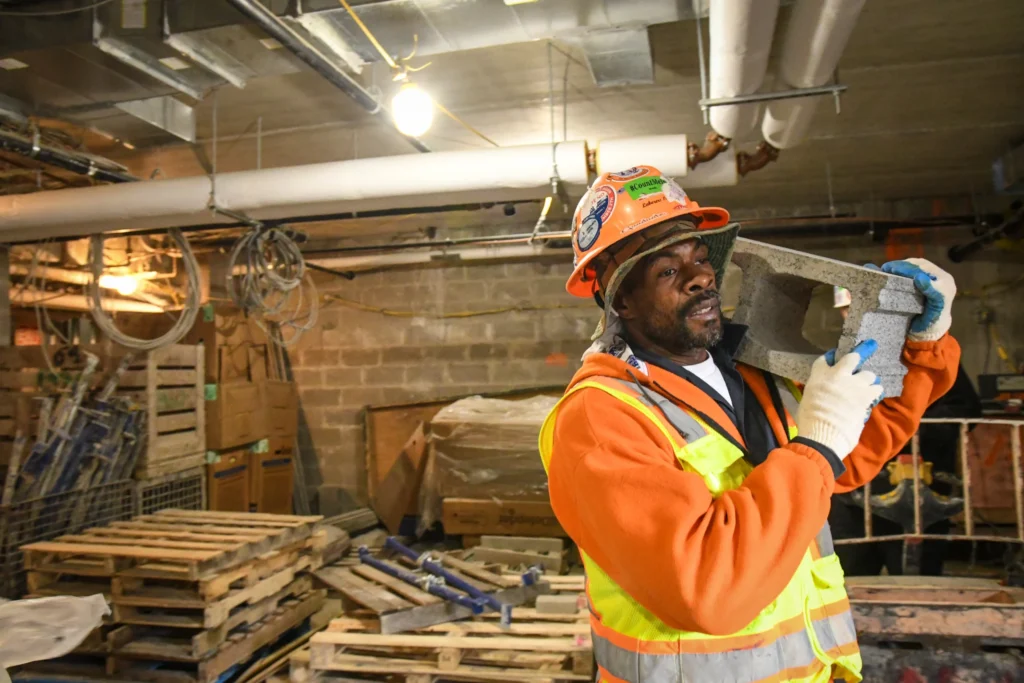
    Maintenance work at NYCHA’s Boulevard Houses in East New York, Brooklyn, Nov. 19, 2025. One family at the privately managed complex said they have been slapped with $45,600 in arrears thanks to a paperwork screw-up by the housing authority. Credit: Ben Fractenberg/THE CITY

    As of last month, this resident was told she had $45,600 in alleged arrears.

    Spokespersons for Boulevard Together, the management firm at the Boulevard Houses, and C+C, the manager at Penn-Wortman and Linden, declined to comment and referred questions to NYCHA.

    Though multiple tenants continue to be told they are tens of thousands of dollars in arrears, housing authority spokesman Sklar said that once advocacy groups and lawyers confronted NYCHA with the problem, the recertifications were processed and the erroneous termination letters nixed.

    The erroneous arrears will ultimately be erased from the records, he said.

    According to the New York City Housing Authority, recertifications can be completed and submitted online through NYCHA’s Self-Service Portal (selfserve.nycha.info) — accessible via computer, smartphone, or tablet. Paper copies of the interim/annual recertification can also be requested by contacting the Customer Contact Center at 718-707-7771. 

  • Tenant Associations: How to Call for an Election

    Tenant Associations: How to Call for an Election

    If your Tenant Association believes a Preservation Trust Election is the right next step for your development, it’s important to follow the correct process. Calling for an election requires formal action, clear communication, and compliance with the applicable guidelines.

    This guide walks you through each stage of the process—from confirming your association’s eligibility and gathering the required support to submitting a formal election request and preparing residents for the voting process. By understanding each step, your Tenant Association can help ensure the election is conducted fairly, transparently, and in accordance with established requirements.

    Whether you’re just exploring the idea or are ready to move forward, this resource provides the information you need to confidently begin the Preservation Trust Election process.

  • What RAD/PACT Really Means for Your Building

    What RAD/PACT Really Means for Your Building

    If you’ve heard the terms RAD (Rental Assistance Demonstration) or PACT (Permanent Affordability Commitment Together) but aren’t sure what they mean, you’re not alone. These programs are designed to bring much-needed funding to public housing communities by allowing properties to access private financing while remaining permanently affordable.

    For residents, the goal is to improve building conditions without changing who the housing is meant to serve. Renovations may include updated apartments, modern building systems, enhanced accessibility, improved security, and long-overdue repairs that public housing funding alone may not be able to cover.

    A RAD/PACT conversion does not mean your building is being sold or that affordable housing protections disappear. Residents retain important rights and protections, including long-term affordability, lease protections, and opportunities to stay informed and involved throughout the process.

    Understanding how RAD/PACT works can help you make informed decisions about your community’s future. Learn what these programs mean, what changes you can expect, and how they may impact your building and your rights as a resident.

  • Residents Rally for Preservation Trust Elections

    Residents Rally for Preservation Trust Elections

    Across communities, residents are coming together to support Preservation Trust Elections as a way to invest in the future of their buildings. By organizing, sharing information, and engaging their neighbors, tenants are taking an active role in shaping decisions that affect their homes and communities.

    Preservation Trust Elections give residents the opportunity to vote on a plan that can unlock funding for critical repairs, modernize aging buildings, and preserve affordable housing for future generations. Community participation is essential to ensuring every resident has the information needed to make an informed decision.

    Learn how residents are organizing, what the election process involves, and why community involvement plays such an important role in building stronger, safer, and more sustainable neighborhoods.